


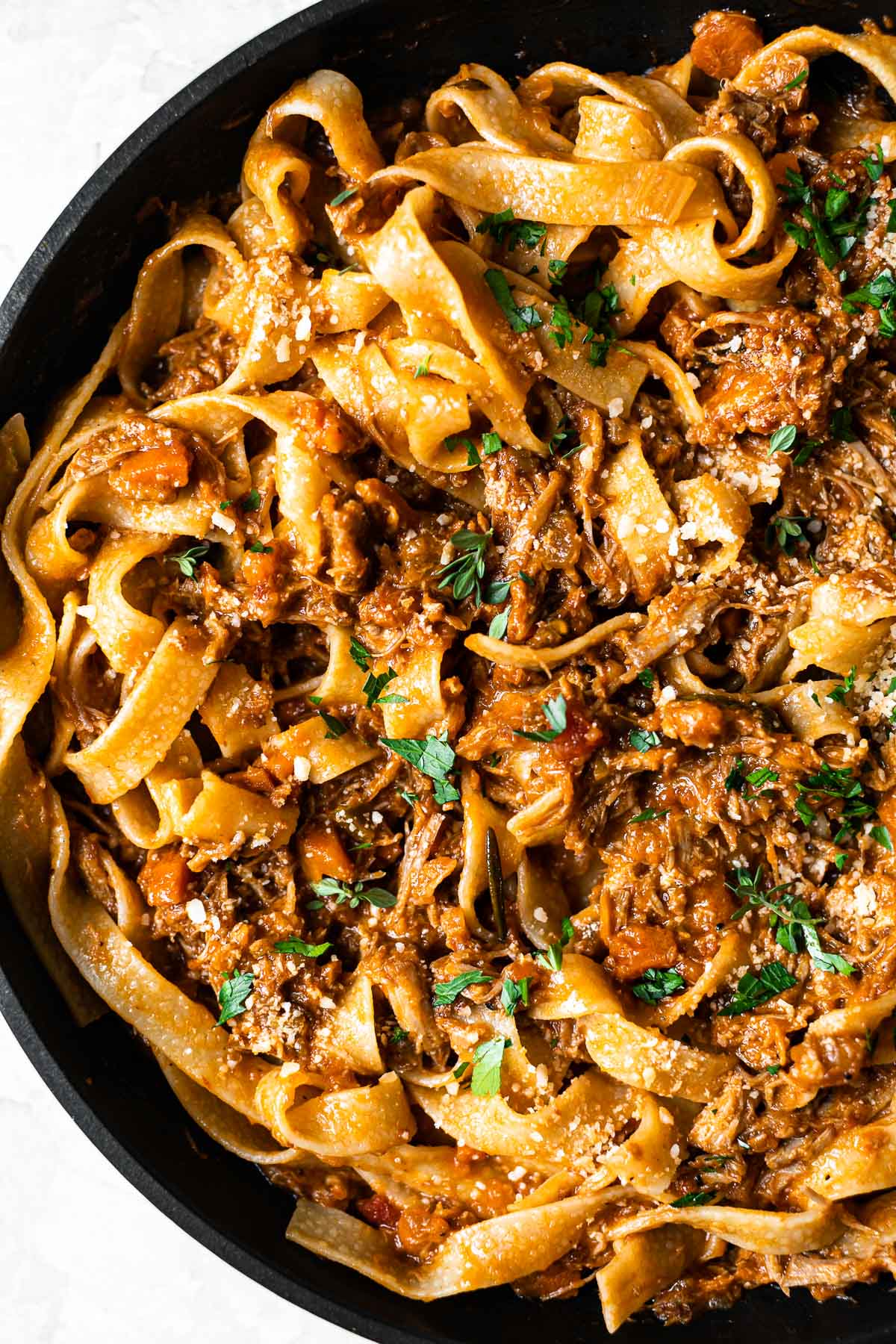
Our Tried and True Pork Ragu – Perfected Over 10 Years and Loved by All!
During my gap year after college, I worked in a fine-dining Italian restaurant in the heart of downtown Milwaukee where I fell head over heels in love with all things Italian food and wine.
Among the many traditional Italian dishes on our menu was Chef’s specialty – Ragu della Casa, a scratch-made ragu served with fresh, hand-cut pappardelle that would highlight a different main ingredient each week.
My personal favorite? Maiale – braised pork ragu.
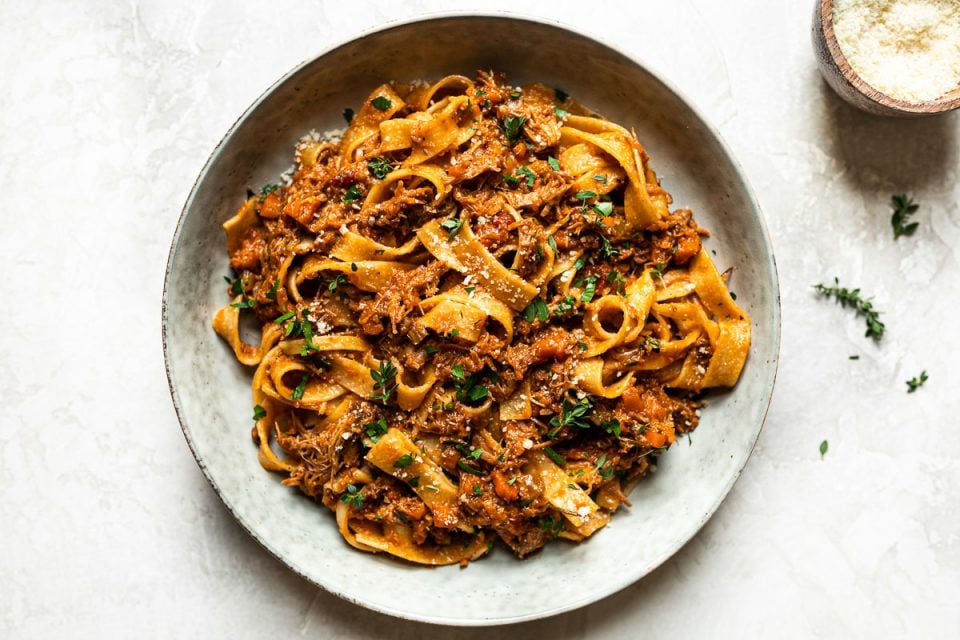
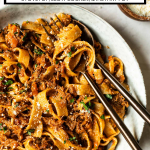
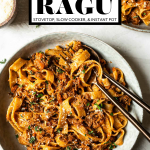
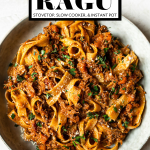
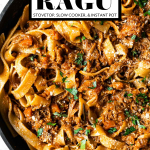
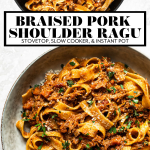
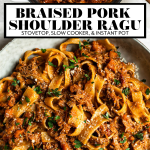
This Slowly Braised Pork Pappardelle is my take on that authentic Italian restaurant dish: succulent, melt-in-your-mouth pork shoulder simmered in a rich tomato sauce and tossed into pappardelle pasta.

The process is mostly hands-off, but a few small details – like deeply caramelizing the soffritto, using a generous amount of fresh herbs, and cooking it low and slow via a stovetop simmer – make all the difference.
The result is a restaurant-worthy pork shoulder ragu sauce that begs to be tossed with pappardelle pasta or spooned over creamy polenta.
It’s cozy, indulgent and feels especially celebratory making it the perfect choice for occasions like Valentine’s Day or Christmas but it’s also the kind of thing that’s really easy to make at home (with guidance to adapt the recipe for an oven braise, or in a slow cooker or Instant Pot too!). You will love it and we can’t wait for you to give it a try!

Easy Ways to Make Your Pasta Dinner Taste As Good As Any Trattoria 🍝
Get 5 days of pasta tips learned from my years in a fine-dining Italian restaurant.
Quick Recipe Background ⇢ What is Ragu?
Ragu is a term used to describe a slowly simmered, hearty Italian meat sauce typically served with pasta. While ragu usually has slowly simmered tomatoes (like marinara sauce) and it’s usually finished with milk or cream (like creamy pasta dishes), it’s its own category of Italian pasta sauce.
It tends to be slowly cooked and rich in flavor, and it’s meant to really showcase the meat like lamb or braised short rib, (or another meaty element, like mushrooms) at the center of the dish. Perhaps, without even knowing it, you’ve enjoyed the most famous ragu – bolognese!
If you’ve never made ragu before, trust that you’re in good hands here. I’ve been cooking various ragu recipes for the past 10+ years. It’s one of my favorite things to cook and I’m know you’ll love it too!
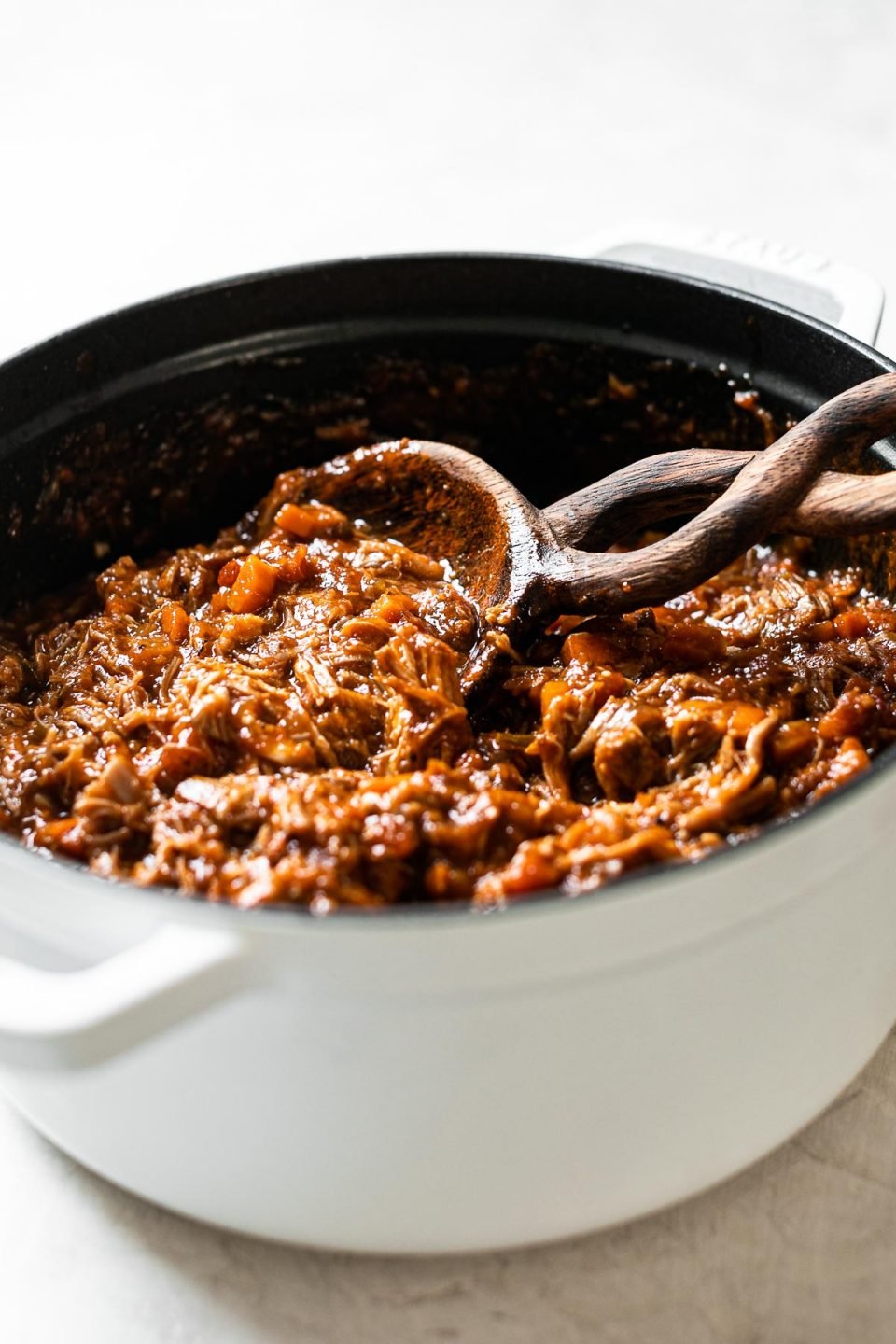
Key Ingredients
This pork shoulder ragu recipe definitely leans into the Italian philosophy of giving a few simple, high-quality ingredients a little TLC to make them absolutely shine.
Most, if not all, of the ingredients used in this recipe are staples in any well-stocked kitchen.
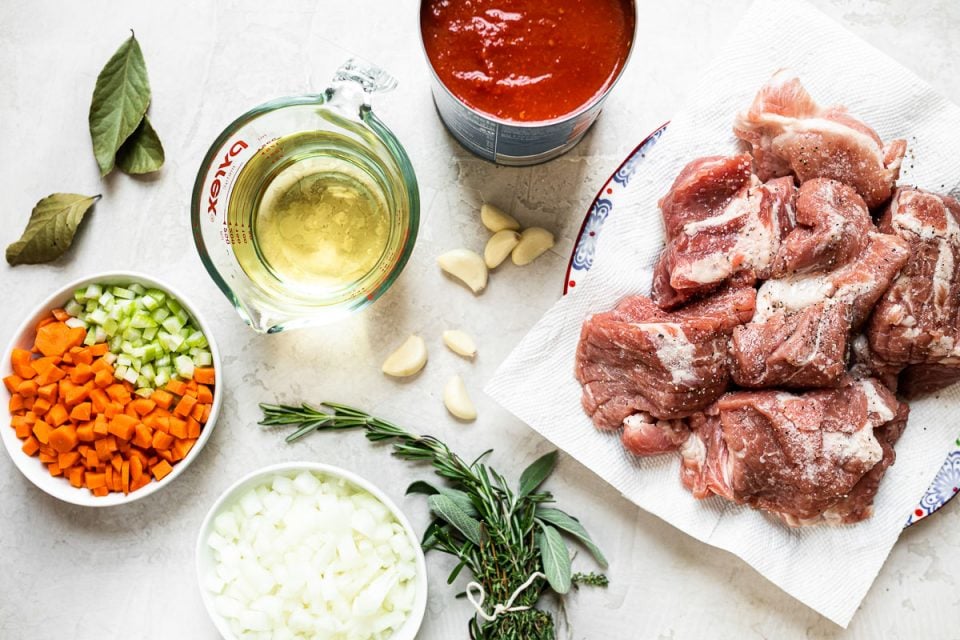
What is the best meat for pork ragu? ⇢ Boneless pork shoulder, which is also commonly called a Boston butt or pork butt. Look for a meaty roast with nice marbling, which, when braised, transforms into succulent, fall-apart tender pork and richly, deeply flavored sauce.
Other key ingredients:
- Wine. It wouldn’t be pasta sauce without a little wine! Typically you’ll find that ragu recipes call for bold red wine. Since the flavor of the pork is a little more delicate, I opt for white wine in this pork shoulder ragu. Any nice, dry white will do the trick…bonus points if its Italian!
- and lastly, a little heavy cream and parmesan to help bring the sauce together.
Meal Prep Tip!
Nearly all of the hands-on prep for this braised pork ragu comes from chopping up the soffritto. I like to take about 15 minutes to chop everything up ahead of time so when I’m ready, I can jump right into cooking. You can even store the veggies in an airtight container in the refrigerator for up to 5 days.
Restaurant-Worthy Pasta Essentials
 Buy Now →
  Buy Now →
  Buy Now →
  Buy Now →
 How to Make Braised Pork Ragu
This pork ragu comes together to 3 main phases: browning, deglazing, and simmering. Each step adds depth – from browned meat to deglazed fond, and finally, a long, gentle simmer that brings everything together.
Patience is key to pulling big flavors out of a ragu’s simple ingredients. It takes some time, but the results are so worth it! The good news is most of the work is entirely hands-off – just let it simmer on the stovetop while you enjoy your day. (Or, let your oven, slow cooker, or Instant Pot do the work – more on that below!)
First, Brown the Pork and the Soffritto Mixture
This is where the magic happens. As you slowly brown the meat and soffritto their flavors deepen through the Maillard reaction, a key process in creating rich, complex ragu sauce.

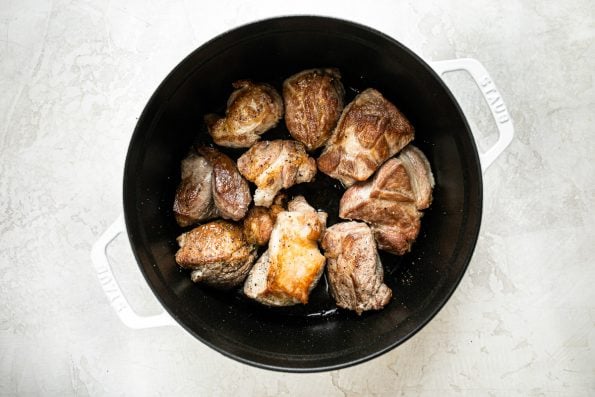
Season the pork, then brown it well in olive oil. Be sure to let each side cook untouched for several minutes until deeply golden brown. Why? ⇢ A beautiful crust on the meat prevents it from drying out as it braises by locking in all of its juices. (No sad, dried-out pork here!) Plus, as the meat browns, it leaves browned bits on the bottom of the pan (fond being the technical French term), which is what creates the base flavor of the braising liquid.

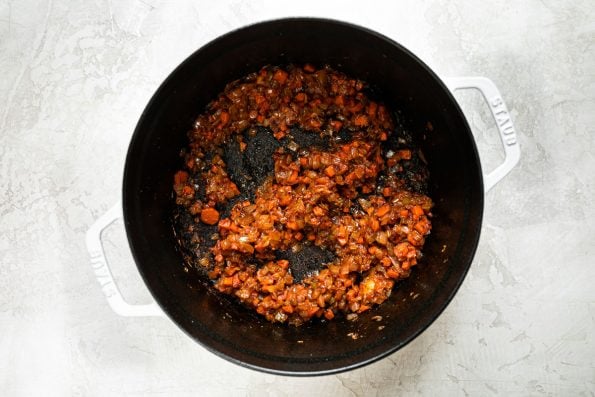
Add the carrots, celery, and onion to the same pot used to brown the pork and cook until borderline caramelized, about 20 minutes. Then add the garlic and tomato paste and cook 5 minutes more until deeply browned. Why? ⇢ Time coaxes out all their flavors and leaves more fond in the pot which translates to big flavor in the braising liquid – letting the aromatics really brown is the difference between a good ragu sauce and a great ragu sauce.
Deglaze the Pan
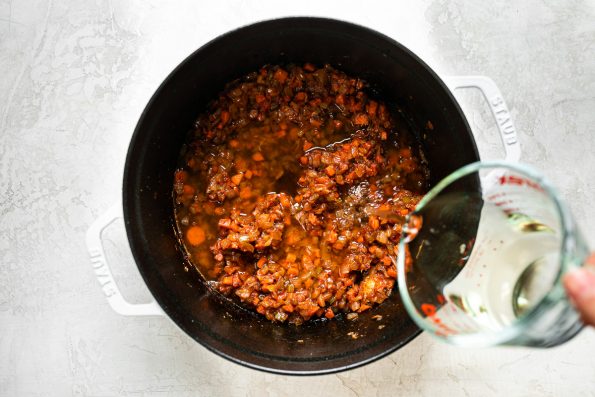
Once the base ingredients are browned, deglaze with white wine, which loosens the caramelized bits from the pot and incorporates their intense flavor into the sauce.

Slowly add in the white wine, scraping up the browned bits of fond from the bottom. Let the wine reduce until it’s is almost completely absorbed into the soffritto. Why? ⇢ The fond contains tons of flavor, and deglazing ensures it’s fully incorporated into the sauce.
Build the Ragu Sauce and Simmer
Simmering the sauce for at least 2 ½ – 3 hours lets it reduce, concentrate, and develop a complex, rich flavor. This is when everything comes together, slowly melding and intensifying. The longer it simmers, the better it gets!

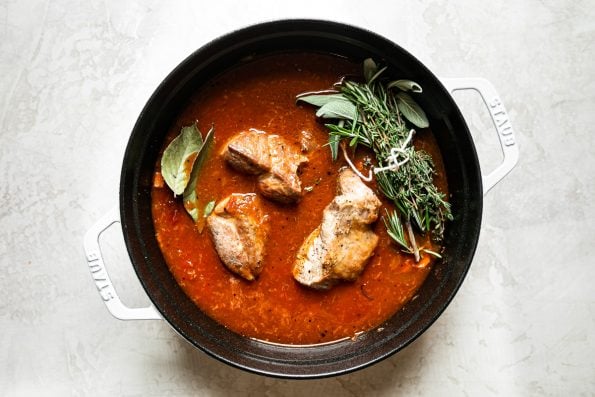
Once deglazed, build the ragu by adding in the rest of its components: fresh herbs, bay leaves, tomatoes, and some cooking stock. Transfer the browned pork back into the pot, nestling it into the sauce. Bring the mixture to a boil, then cover the pot and reduce to a simmer for a solid 2 ½ – 3 hours. Why? ⇢ A long simmer allows all of the flavors to meld together and low and slow heat gently breaks down the connective tissue in the beef, tenderizing the meat.
Finishing Touches


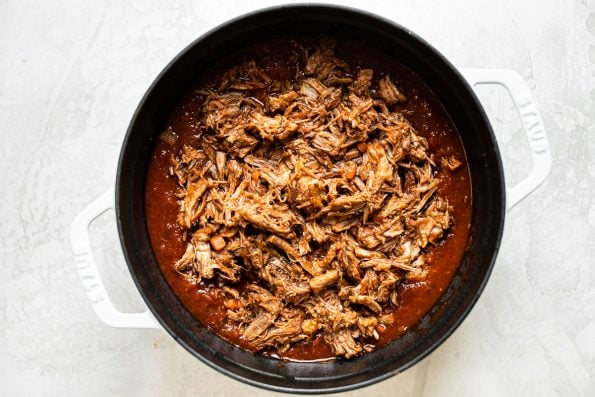
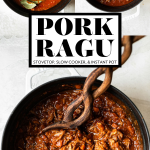
Once the pork is fall-apart tender, transfer it to a plate or cutting board and use tongs or a couple of forks to shred it into bite-sized pieces. Feel free to shred it as chunky or fine as you’d like. Return to the pot and stir it into the sauce. Stir in heavy cream and parmesan for a luscious finish before serving with your cozy carb of choice!
Alternate Cooking Methods
While stovetop braising is our method of choice, you can easily adapt this braised pork ragu for a few different cooking methods. Check the Recipe Notes, below, for step-by-step guidance on cooking your ragu in the oven, slow cooker, or Instant Pot.
Serving Suggestions
Serving ragu is not quite as simple as spooning it over your pasta of choice!
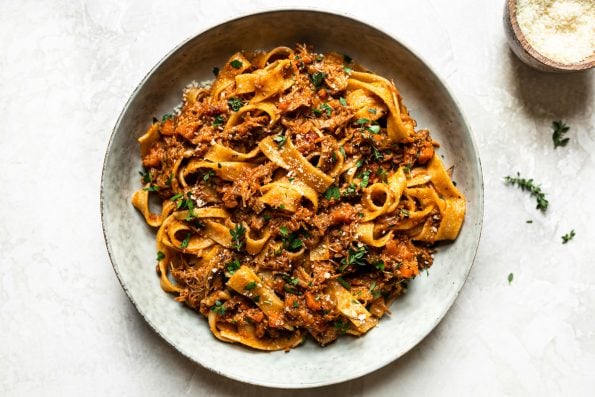
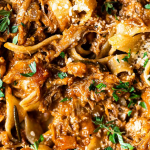
What is the best pasta for ragu sauce? ⇢ I love serving this pork shoulder ragu with a wide and flat noodle, such as pappardelle; its width stands up to the bits and pieces in the ragu sauce beautifully. If you prefer to use a short noodle, try rigatoni; its tubular shape catches and encases the ragu sauce for the most perfect bites of pasta.
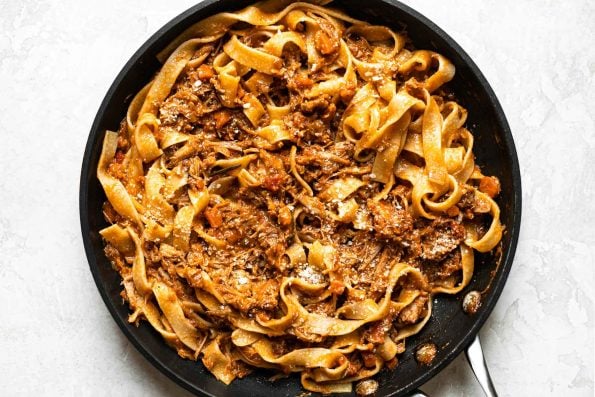
The #1 mistake I see home cooks make when preparing a pasta dish is simply plopping sauce on a plate of cooked pasta. Please don’t do this! For restaurant-worthy results, always simmer your al dente pasta with the bolognese sauce before serving. To learn more, check out my complete guide for How to Cook Pasta Perfectly Every Single Time.
I always serve my pork ragu alongside Garlic Lover’s Garlic Bread and a bistro-inspired Mixed Greens Side Salad for a restaurant-quality Italian dinner at home!
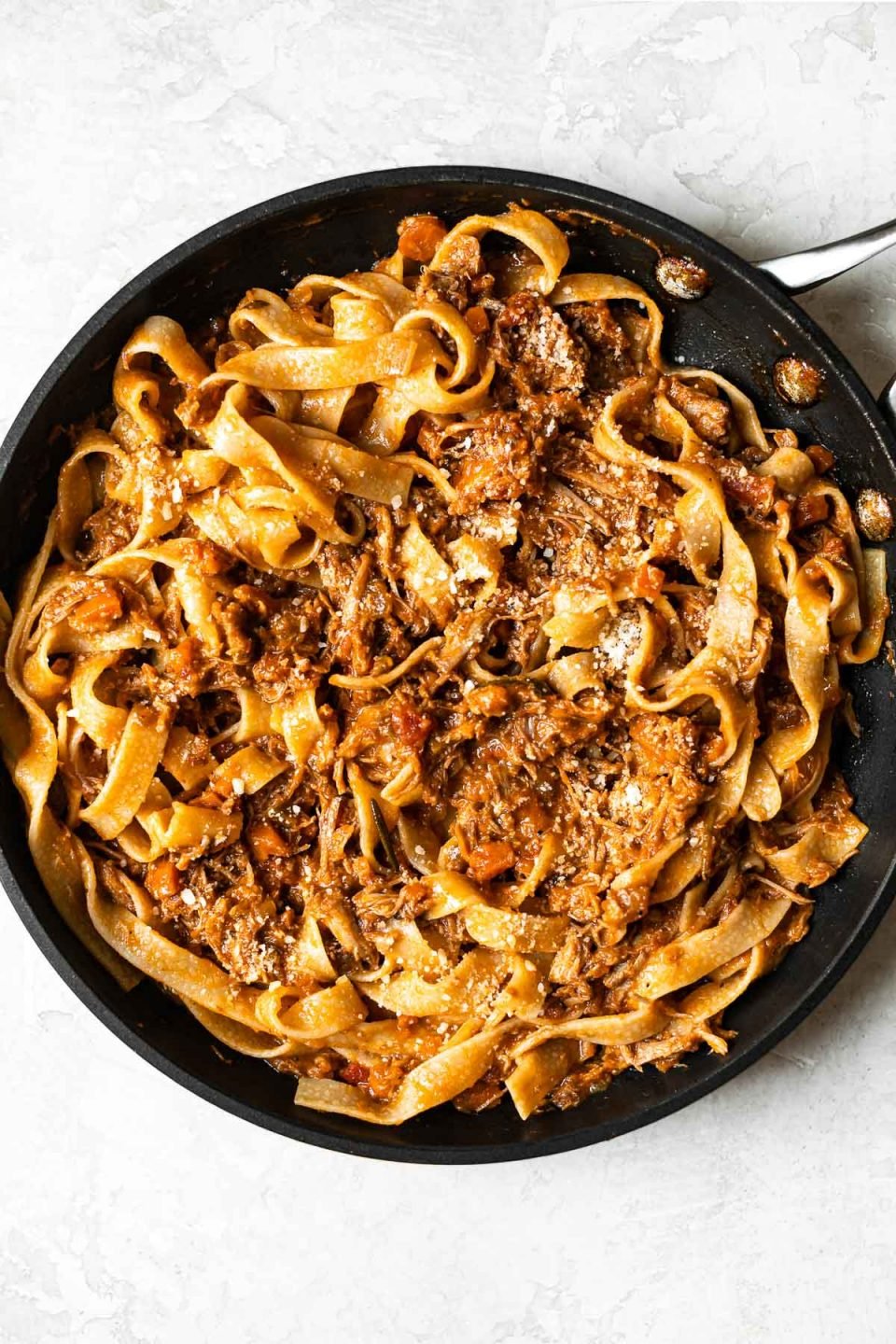
Make Ahead, Storage, and Freezing
Pork Ragu stores super well – its flavors develop and get even better the longer it sits! Feel free to prep a batch of sauce ahead of time. It will keep in the refrigerator for 4-5 days or in the freezer for up to 3 months. Check the Recipe Notes, below, to learn more!
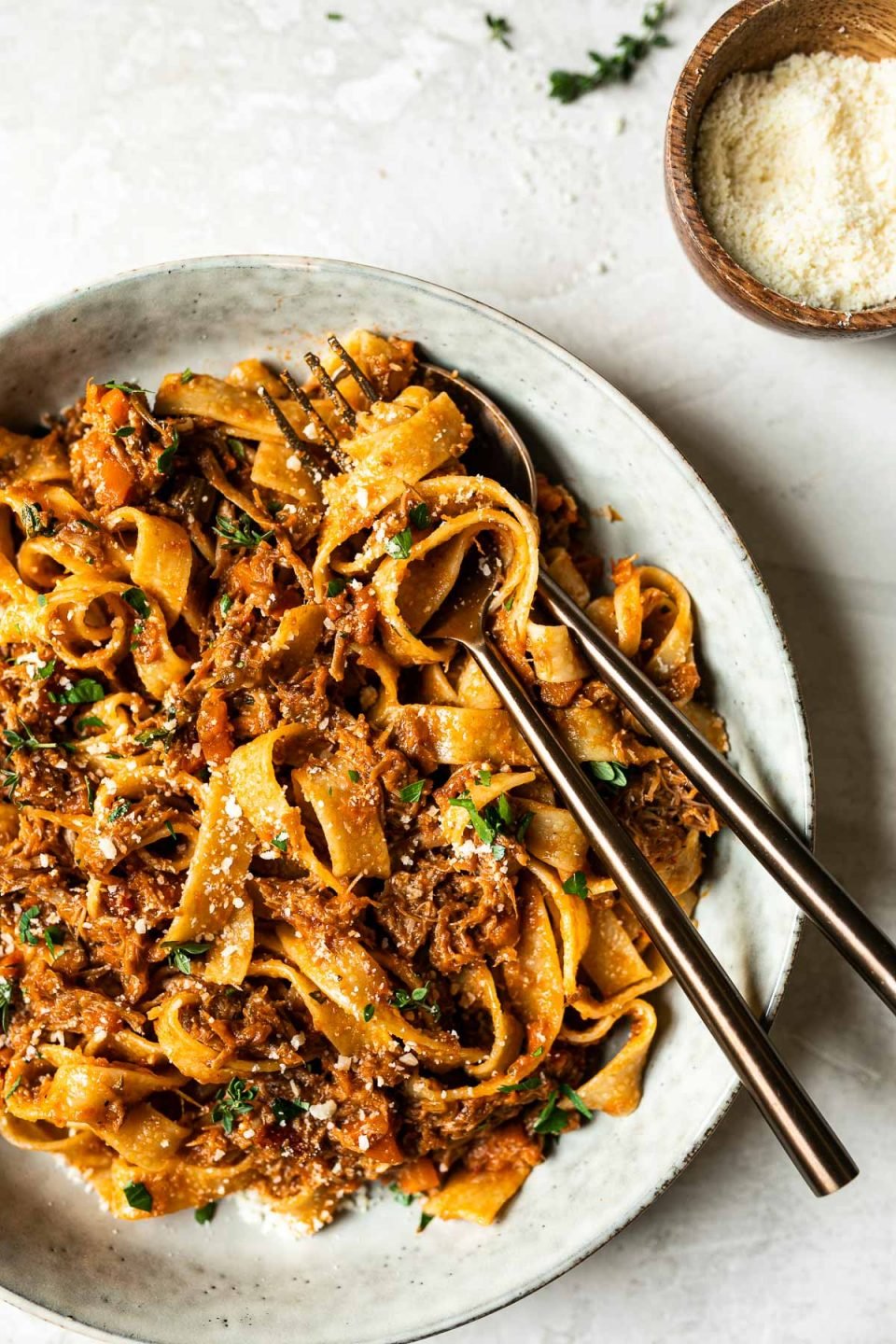
I can’t wait for you to make Braised Pork Ragu Pappardelle in your own kitchens this fall and winter. This is one of my signature recipes, and I know you’re going to love it as the cozy season sets in this year.
If you do give it a try, be sure to let me know! Leave a comment with a star rating below. You can also snap a photo and tag @playswellwithbutter on Instagram. We LOVE seeing your PWWB creations! Happy cooking! ♡
Print
Slowly Braised Pork Ragu with Pappardelle
- Prep Time: 25 minutes
- Cook Time: 3 hours
- Total Time: 3 hours 30 minutes
- Yield: serves 10–12 1x
- Category: Pasta Recipes, Main Dish
- Method: Stovetop, Braise
- Cuisine: Italian
Description
This Slowly Braised Pork Ragu Pappardelle is the ultimate comfort food meal!
Succulent, juicy pork shoulder slowly simmers in a rich tomato sauce until it’s fall-apart tender and able to shred with a fork. Finish with a splash of cream and generous sprinkling of parmesan. then toss the pork shoulder ragu into pappardelle pasta for the best homemade Italian meal.
Stovetop, oven, slow cooker and electric pressure cooker directions provided.
Ingredients
for the Braised Pork Ragu Sauce:
- 3 tablespoons olive oil, divided
- 2 ½ pounds boneless pork shoulder, trimmed of excess fat and cut into 6 large pieces
- 3 large carrots, peeled and diced
- 1 large yellow onion, finely diced
- 1 stalk celery, finely diced
- 8 cloves garlic, finely chopped or grated
- 2 tablespoons tomato paste
- 1 cup dry white wine
- one (1) 0.75-ounce package fresh “poultry herb blend” (or approx. 2 sprigs fresh rosemary, 4 sprigs fresh sage leaves and 12 sprigs fresh thyme)
- 2 bay leaves
- one (1) 28-ounce can crushed tomatoes
- 2 cups water or low-sodium chicken broth or stock
- kosher salt and ground black pepper, to season
for the Pork Ragu Pappardelle:
- 20–30 ounces dried pappardelle pasta or other pasta of choice
- ½ cup heavy cream
- heaping ½ cup grated parmesan
- for serving, as desired: grated parmesan, finely chopped fresh herbs, etc.
Instructions
Braised Pork Ragu Sauce:
- Brown the pork shoulder: Add 2 tablespoons olive oil to a large, heavy-bottomed pot (I use a 5-qt Dutch oven) over medium-high heat. Use paper towel to pat the pork shoulder as dry as possible. Generously season the pork shoulder with 2 teaspoons each kosher salt and ground black pepper. Once the oil in the pot shimmers, carefully add in the seasoned pork shoulder. Work in batches, as necessary, to avoid overcrowding the pot (which prevents browning). Cook for 4-5 minutes per side, until nicely browned. Transfer the browned pork to a plate and set aside.

- Brown the soffritto: If needed, add the remaining 1 tablespoon olive oil to the same pot used in Step 1 and reduce heat to medium. Once hot, add in the soffritto (carrots, onion, and celery), seasoning with ½ teaspoon each kosher salt and ground black pepper and stirring to combine. Cook, stirring occasionally, until deeply browned, 15-20 minutes.
- Add aromatics. Add the garlic to the pot with the soffritto. Stirring constantly, cook until fragrant, 1-2 minutes. Add the tomato paste to the pot, stirring to coat the soffritto. Cook 2-3 minutes, until browned.
- Deglaze: Increasing the heat to medium-high, pour the white wine into the pot. Stir constantly, using a wooden spoon to scrape up any browned bits that may have formed at the bottom of the pot. Cook for 4-5 minutes, until the wine is almost completely absorbed into the soffritto.
- Simmer: Tie the herbs together using kitchen twine (or finely chop if you do not have twine), then add to the pot with the bay leaves. Add the crushed tomatoes, water (or broth/stock), and browned pork shoulder from Step 1. Stir to combine. Bring the mixture to a boil. Reduce heat to maintain a gentle simmer. Cover and cook, stirring occasionally, for 2 ½ – 3 hours, or until the pork is fall-apart tender. If the ragu begins to reduce too much (i.e. it loses too much of its liquid too quickly), feel free to add in a splash more water and/or reduce the heat further.
- Finish the braised pork ragu: Carefully transfer the pork to a plate or cutting board. At this point, you can remove and discard the spent herbs and bay leaves from the pot, as well. Use tongs or 2 forks to shred the pork into bite-sized pieces. Return the shredded pork to the pot with the ragu. Stir to combine. At this point, you can cool and store for later use (see Recipe Notes for storage and freezing directions), or proceed with making the pork ragu pappardelle (below).
Pork Ragu Pappardelle:
- Boil the pasta: Bring a large pot of salted water to a boil. Add the pappardelle and cook, stirring occasionally, until the pasta is cooked to al dente according to package directions. Carefully dip a liquid measuring cup into the pot, reserving about 1 cup of the starchy pasta water, and set aside. Carefully drain the pappardelle – do NOT rinse it!
- Finish the pork ragu sauce: Meanwhile, as the pasta boils, bring the braised pork ragu up to a simmer. Stir in the heavy cream and parmesan cheese. Continue to simmer over low heat, stirring occasionally.
- Pork ragu pappardelle: Add the cooked pappardelle pasta to the pot with the braised pork ragu sauce, tossing to coat. The pork ragu should evenly coat the pasta. Add in some of the reserved pasta water if the ragu needs to loosen up a little; add in an extra handful of parmesan if it needs to tighten up a little. Cook over medium heat for 1-2 minutes, allowing the pasta to meld with and absorb some of the ragu.
- Serve: Portion the pork ragu pappardelle into individual pasta bowls, topping with additional grated parmesan, chopped fresh herbs, and/or crushed red pepper as desired. Serve immediately. Enjoy!
Notes
- Make-Ahead, Storage and Freezing:
- Storage Instructions: Pork ragu sauce stores incredibly well – it’s the type of thing that gets even better as it sits and its flavors have the chance to meld together. To store, prep the sauce through Step 6 of Recipe Directions, above. Once cooled, transfer to an airtight container and store in the refrigerator for 4-5 days. Whip up a batch of pork ragu pappardelle during the week by reheating the braised pork ragu in a skillet, and completing the recipe according to “Pork Ragu Pappardelle” Steps 1-4, above.
- Freezing Instructions: Pork ragu is also incredibly freezer-friendly. To freeze, transfer the cooled pork shoulder ragu sauce to a freezer container (or divide it up between multiple freezer containers for smaller portions). Freeze for up to 3 months. To thaw, place the frozen ragu in the refrigerator overnight or submerge the freezer container in room temperature water for a quicker thaw. Reheat the ragu sauce in a skillet. The thawed ragu sauce will be a little watery at first, which is totally expected. Let any residual water simmer out before completing the recipe according to “Pork Ragu Pappardelle” Steps 1-4, above.
- Alternate Cooking Methods:
- Oven Braised Pork Ragu: Prep the recipe according to Steps 1-5, above. Rather than braising on the stovetop, transfer the covered pot to a 325 degree F oven. Braise in the oven for 2 ½ – 3 hours, until the pork is fall-apart tender, then finish the pork ragu sauce as directed in Step 6 and complete the recipe according to “Pork Ragu Pappardelle” Steps 2-4.
- Slow Cooker Pork Ragu: Prep the recipe according to Steps 1-4, above. Transfer the soffritto mixture to the slow cooker, along with the aromatics, tomatoes, water (or broth), and browned pork shoulder as directed in Step 5. Slow cook on high for 4-5 hours or on low for 7-8 hours, stirring occasionally. Finish the pork ragu sauce as directed in Step 6 and complete the recipe according to “Pork Ragu Pappardelle” Steps 2-4, which you can do right in your slow cooker. If your slow cooker has a searing/browning feature, you can use it to cook the entire ragu sauce recipe (Steps 1-6) in the slow cooker.
- Electric Pressure Cooker Pork Ragu: Use your electric pressure cooker’s “Sauté” setting to cook the recipe according to Steps 1-5, above. Cover and seal the pressure cooker and cook on manual high pressure for 50 minutes. Allow the pressure cooker to naturally release pressure for 10 minutes before carefully flicking the valve to its “venting” position to vent out any residual pressure. If the ragu seems a little too liquidy, feel free to turn on the Sauté setting again, letting the sauce simmer down a little before finishing as directed in Steps 6. Complete the recipe according to “Pork Ragu Pappardelle” Steps 2-4, which you can do right in your pressure cooker pot.
Nutrition
- Serving Size:
- Calories: 258
- Sugar: 6 g
- Sodium: 380.4 mg
- Fat: 8.7 g
- Saturated Fat: 2 g
- Trans Fat: 0 g
- Carbohydrates: 12.6 g
- Fiber: 2.9 g
- Protein: 28.7 g
- Cholesterol: 68 mg
Follow along with Plays Well With Butter on Instagram, YouTube, Facebook, and Pinterest for more unfussy recipes that pack a big punch of flavor!


When defrosting something in water, use ice water. It is actually quicker and safer (you want to keep the meat out of the danger zone temperatures). If the ice melts, add more.
Hi Heather, we appreciate you looking out for everyone’s safety! The USDA says to use cold water and to replace the water every 30 minutes or so, until the item is thawed, so we encourage everyone to follow their safety guidelines.
This was amazing. I’ve never made a ragu, and this was 10/10. The flavors were perfect, and I’d serve this to guests in a heartbeat. I prepped it last night, and then I cooked it in a slow cooker today.
We’re so glad to hear you enjoyed it, Taylor. Prepping it the night before so you can toss it all in the slow cooker in the morning is so smart!